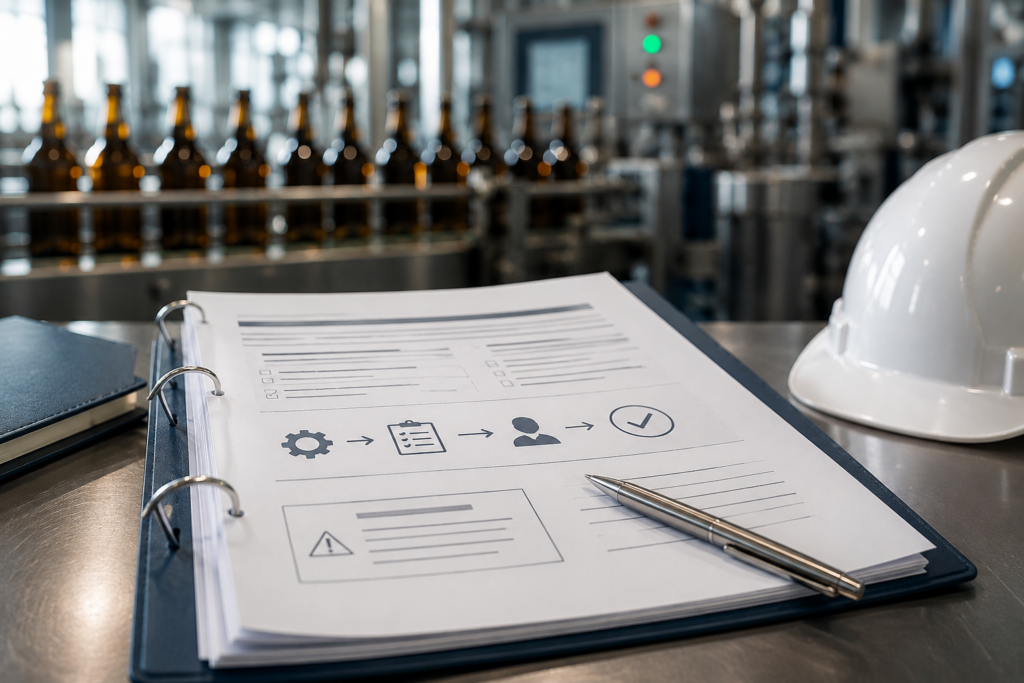
Revismo conducted a training session at A. Le Coq, an Estonian brewery, focused on manual development and document management, with the main objective of improving how manuals are used in everyday operations. The training was not only about creating documents, but about ensuring that manuals genuinely support daily work, employee onboarding and consistent ways of working.
In manufacturing environments, the key issue is usually not whether manuals exist. More important is whether they are practical, up to date and aligned with the actual production process. This is what determines how effectively manuals support quality, safety and operational reliability.
A manual is not just a document
During the training, manuals were approached as part of a wider operational system. A manual works effectively when it is connected to the actual workflow, employee training, supervision and document control. If a manual exists but is not used, or no longer reflects the real process, its practical value quickly decreases.
Topics covered during the training included:
- how to keep manuals aligned with actual production processes
- how to integrate manuals into onboarding and daily operations
- how to make manuals easy to access, easy to understand and easy to maintain
What makes a manual effective?
An effective manual:
- reflects the actual work process
- is clear and logically structured for the user
- is easy to access when needed
- presents essential information clearly and practically
- supports quality, safety and consistent working practices
- is up to date and supported by clear document control and version management
The training also covered how to gather the right input for manual development, why workplace risk assessments must be considered and how to avoid situations where outdated versions remain in circulation.
The value of a manual does not come from simply having a document in place or formally completing it. Real value is created when manuals genuinely support the work being carried out, help employees make the right decisions at the right time and are closely connected to the actual production environment.
The training on manual development and document management was important for us because, in a manufacturing environment, manuals directly affect daily operations, quality and safety. Manuals are not just a formal requirement or documentation — they are practical working tools that support both everyday work and employee training.
The training helped clearly explain why it is not enough for manuals to simply exist. For us, it is essential that manuals reflect the actual work process, are easy for employees to understand and can be quickly accessed when needed. Only then can manuals truly support consistent ways of working and help prevent mistakes and deviations.
We would like to thank the trainer for a valuable and insightful session that provided clear and practical ideas for further improving our manuals.
Feedback from A. Le Coq on the training