
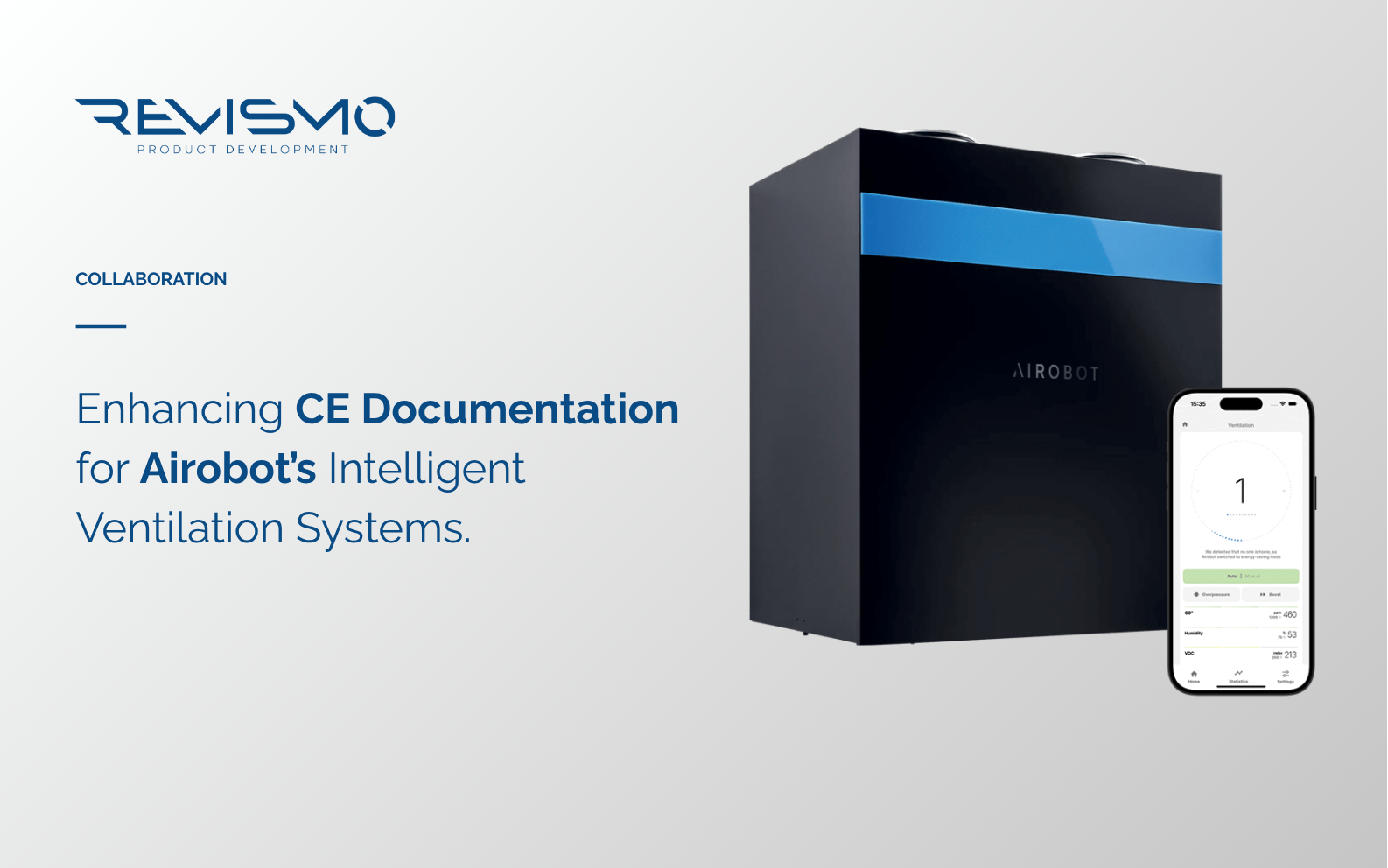
Airobot is an Estonian technology company that develops and manufactures intelligent ventilation and indoor climate solutions designed to improve air quality and maintain a healthy indoor environment. Its products combine ventilation technology, sensors, and intelligent control systems that automatically adapt operation according to actual needs.
As product complexity and production volumes increase, it becomes increasingly important to keep technical documentation, risk assessments, manuals, and declarations of conformity up to date.
To support this effort, Airobot engaged Revismo to review and update the CE documentation for its ventilation units and heating-category products. The project covered ventilation systems and their associated accessories. Revismo’s work included identifying applicable regulations, preparing risk assessments in accordance with ISO 12100, updating operation and maintenance manuals, and revising declarations of conformity.
Why Was the Project Important?
Airobot’s products are far more than purely mechanical devices. Ventilation and indoor climate control systems involve a combination of electrical safety, electromagnetic compatibility, radio communication, software, control systems, operational safety, maintenance requirements, product marking, and user information.
For products of this type, CE documentation cannot be treated as a formal final step. Compliance must reflect the actual design, functionality, and intended use of the product. As products evolve, technical documentation must evolve with them to ensure that it accurately represents the product and demonstrates compliance with applicable regulations.
For Airobot, it was important to update and enhance existing documentation so that it would continue to support manufacturing, market access, and future product development.
What Did Revismo Do?
The first phase of the project involved identifying the applicable European Union requirements. We determined the directives, regulations, and standards relevant to the ventilation products and mapped the resulting compliance obligations.
Revismo then carried out product risk assessments. The evaluation covered the entire product lifecycle, including transportation, installation, operation, maintenance, fault situations, and end-of-life disposal.
Next, we updated the operation and maintenance manuals. These documents needed to be both technically accurate and easy for users to understand. A well-designed manual supports correct installation, safe operation, maintenance activities, troubleshooting, and understanding of product limitations.
As part of the project, declarations of conformity were also updated to reflect current product information, manufacturer details, and applicable regulatory requirements.
What Value Did the Project Deliver to Airobot?
The value of the project extended beyond documentation updates. It helped establish a structured framework that Airobot can continue to use to support manufacturing, market access, and ongoing product development.
In smart indoor climate solutions, components, software, functions, user interfaces, and regulatory requirements are constantly evolving. Documentation must therefore be structured in a way that allows it to be maintained efficiently and kept aligned with product changes.
One particularly positive aspect of the project was that CE documentation was not treated as a separate administrative requirement, but as an integral part of product development and quality management. This is especially important for products where mechanics, electronics, and software combine to create a single integrated user experience.
Key Takeaways
In product development, compliance risks often arise when technical solutions evolve faster than the supporting documentation. This is particularly common in rapidly growing companies, where prototypes become commercial products and product portfolios continue to expand.
The Airobot project demonstrated that CE documentation is most effective when it is maintained systematically and developed alongside the product itself. This gives manufacturers a clearer understanding of applicable requirements, potential risks, and the documentation needed to support successful market placement.